
- Why SEO Matters for Ecommerce Websites
- How to Conduct Ecommerce Keyword Research
- Optimizing Product Pages for Search Engines
- Category Page SEO Strategy and Best Practices
- Technical SEO Foundations for Ecommerce Sites
- Building an Ecommerce Link Strategy
- Common Ecommerce SEO Mistakes to Avoid
- Product Page SEO vs. Category Page SEO
Nearly 40% of revenue for the typical ecommerce business comes from organic search. Paid advertising brings immediate visitors, but SEO creates a self-sustaining asset that keeps delivering qualified traffic months and years later. Unlike PPC campaigns that disappear the second you stop funding them, a properly optimized product page can attract buyers continuously.
Why SEO Matters for Ecommerce Websites
The economics of ecommerce search optimization explain why it deserves strategic focus. Acquiring a customer through organic rankings typically costs 60-70% less than through paid channels. Across twelve months, this difference compounds exponentially. A store investing $50,000 annually in Google Ads might bring in 2,000 customers. The same budget allocated to SEO could generate 5,000+ customers with stronger retention, since organic searchers often show higher purchase intent.
Beyond cost per acquisition, organic traffic delivers stability. Setting aside algorithm changes, your positions don’t evaporate when budgets shrink or competitors increase ad spend. During economic contractions or seasonal downturns, organic search functions as a revenue stabilizer. Stores that established robust SEO programs before the 2025 retail slowdown preserved revenue while competitors relying on paid channels experienced 40-60% declines.
The extended value becomes evident when examining customer lifetime value. Organic visitors convert at comparable rates to paid traffic (approximately 2-3% across most categories), yet they return with greater frequency. Someone who finds your store by searching “organic cotton baby clothes” has already shown specific intent. They’re evaluating options, making comparisons, and prepared to purchase—not simply clicking because an advertisement interrupted their activity.
How to Conduct Ecommerce Keyword Research
Strategic ecommerce keyword research begins by aligning your inventory with search demand, never the opposite. Too many stores pursue high-volume keywords disconnected from their actual merchandise. Start with your product catalog: export your SKUs, categories, and specifications into a spreadsheet. This forms your baseline.
Interpreting search intent distinguishes profitable keywords from empty traffic metrics. Someone searching “running shoes” might seek buying guides, reviews, or nearby retailers. Someone searching “women’s size 8 Nike Pegasus 42 white” is purchase-ready. Both have merit, but they target different pages and funnel positions. Product pages should capture bottom-funnel, purchase-ready searches. Category pages attract mid-funnel browsers. Blog content addresses top-funnel research questions.
Begin with seed keywords from your merchandise names and categories. A kitchen equipment retailer would start with “stand mixer,” “food processor,” “blender.” Process these through keyword research platforms (Google Keyword Planner, Ahrefs, Semrush) to discover variations: “best stand mixer for bread dough,” “quiet food processor,” “personal blender for smoothies.” Search for modifiers signaling purchase readiness: “buy,” “cheap,” “best,” specific brands, colors, sizes, and model numbers.

Competitor analysis uncovers gaps and possibilities. Select 3-5 thriving competitors and examine which keywords fuel their organic traffic. You’re not duplicating their approach—you’re learning what search demand exists in your market. When a competitor ranks for “commercial-grade stand mixer under $500” and you stock comparable products, that keyword warrants attention. Platforms like Ahrefs’ Site Explorer or Semrush’s Organic Research feature simplify this analysis.
Rank keywords by funnel position and business impact. Establish three tiers: high-intent product keywords (direct revenue potential), mid-funnel category keywords (builds traffic and credibility), and top-funnel informational keywords (long-term brand development). A new store with minimal authority should concentrate 70% of resources on long-tail product keywords where competition remains manageable. An established brand can pursue competitive category-level searches.
One practical method: organize keywords using a custom priority calculation combining search volume, difficulty, and conversion likelihood. Give each keyword a 1-10 rating for monthly searches, a 1-10 inverse rating for difficulty (easier = higher number), and a 1-10 rating for estimated conversion rate based on intent. Multiply these values together. A keyword scoring 6 × 8 × 9 = 432 outranks one scoring 9 × 3 × 5 = 135, despite the second having higher volume.
Optimizing Product Pages for Search Engines
Product pages constitute your revenue-producing territory. Every optimization choice should balance search visibility with conversion performance. A flawlessly optimized page that achieves #1 rankings but converts poorly squanders the traffic it generates.
Product Titles and Meta Descriptions
Your product title fulfills dual purposes: it’s both your H1 heading and the dominant ranking signal for that page. Structure influences outcomes. Begin with the product name, add key specifications, and incorporate your brand. “Men’s Merino Wool Hiking Socks – Cushioned, Moisture-Wicking | [Your Brand]” outperforms “Hiking Socks” or an excessive “Best Men’s Merino Wool Cushioned Moisture-Wicking Thermal Hiking Socks for Cold Weather.”
While meta descriptions don’t influence rankings directly, they profoundly shape click-through performance. Craft them as compact advertisements. Incorporate the primary keyword, a compelling benefit, and a gentle call-to-action. “Our merino wool hiking socks keep feet dry on 12-hour treks. Cushioned heel and arch support. Free returns on all orders.” This surpasses generic descriptions like “Shop our selection of quality hiking socks.”
Don’t use manufacturer-supplied titles exactly as provided. When you and 47 competitors all deploy the identical title from the brand’s product feed, you’re fighting for leftovers. Insert differentiators: your unique value proposition, specific use scenarios, or bundle details.

Product Descriptions and User-Generated Content
Minimal product descriptions destroy rankings. A 50-word paragraph lifted from the manufacturer creates duplicate content problems and delivers no ranking benefit. Target 300-500 words of unique, valuable content. Describe materials, dimensions, use scenarios, and maintenance instructions. Address the questions customers raise before purchasing.
Organize descriptions for scanability. Deploy short paragraphs (2-3 sentences), bullet points for features, and subheadings for different dimensions (Materials, Sizing, Care Instructions). Someone browsing on mobile should capture the essential information in 15 seconds.
User-generated content—reviews, Q&A sections, customer photos—contributes fresh, unique content that search algorithms reward. A product with 50+ reviews containing organic keyword variations (“these socks don’t slip,” “great for cold weather hiking,” “no blisters after 10 miles”) communicates relevance more effectively than any description you compose. Actively solicit reviews through post-purchase emails and eliminate friction in the review process.
One frequently overlooked opportunity: incorporate customer questions directly into your description. When your support team repeatedly clarifies sizing differences or compatibility concerns, that information deserves space on the product page. This reduces support volume while adding keyword-rich, helpful content.
Image Optimization and Alt Text
Product images influence both conversion and SEO performance. File naming conventions matter: “merino-wool-hiking-socks-grey.jpg” surpasses “IMG_2847.jpg.” Descriptive file names supply a minor ranking signal and strengthen image search visibility.
Alternative text supports accessibility and search optimization together. Describe image content precisely: “Grey merino wool hiking socks showing cushioned sole detail” works better than “hiking socks” or keyword-laden nonsense like “best men’s merino wool hiking socks buy online cheap.” Write for a vision-impaired user depending on screen readers, and you’ll naturally create effective alt text.
Compress images while preserving quality. A 2MB product photo requiring 4 seconds to load on mobile damages both rankings and conversions. Solutions like ImageOptim, ShortPixel, or platform-native compression should reduce images below 150KB without noticeable quality degradation. Apply lazy loading for below-the-fold images.
Multiple product images boost conversion rates (customers want comprehensive product views), and they also generate opportunities for image search traffic. Each image represents another potential entry point. Name and tag them distinctly: front view, side view, detail shots, lifestyle images displaying the product in context.
Schema Markup for Products
Product schema communicates to search engines precisely what they’re examining: price, availability, ratings, brand, SKU. This structured data enables rich results in search—star ratings, price, and stock status displaying directly in search listings. Products with rich results earn 20-30% higher click-through rates than standard listings.
Add schema using JSON-LD format (Google’s preference) rather than microdata. Include: name, image, description, SKU, brand, offers (price, currency, availability), aggregateRating (when you have reviews), and review markup for individual reviews. Most ecommerce platforms (Shopify, WooCommerce, BigCommerce) provide plugins or native schema support.
Validate your schema using Google’s Rich Results Test tool to confirm proper implementation. Common errors include missing required properties, incorrect formatting, or conflicting information between schema and visible page content. When your schema indicates “in stock” but the page displays “sold out,” Google disregards the markup.
Keep schema current when prices or availability shift. Outdated schema displaying incorrect prices generates trust problems when searchers click through expecting one price and discover another.
Category Page SEO Strategy and Best Practices
Category pages confront a distinctive challenge: they must rank competitively while functioning as navigation centers. A poorly optimized category page squanders link equity and fails to capture mid-funnel traffic. A properly optimized one can rank for dozens of related keywords and channel visitors to specific products.
Begin with unique, comprehensive category descriptions. The 50-word generic paragraph at the top of your “Women’s Running Shoes” category won’t suffice. Compose 400-800 words covering subcategories, use scenarios, purchasing considerations, and brand comparisons. Position this content strategically—either above the product grid (stronger for SEO, potentially weaker for conversion) or below it (stronger for conversion, still crawlable).
One effective middle ground: position 150-200 words of engaging content above the fold, then expand with additional depth below the product grid. This reconciles user experience with search requirements.
Internal linking architecture determines category page authority. Connect from your homepage to top-level categories. Connect from category pages to subcategories and related categories. Connect from product pages to their parent category. This establishes a logical hierarchy that channels link equity efficiently.
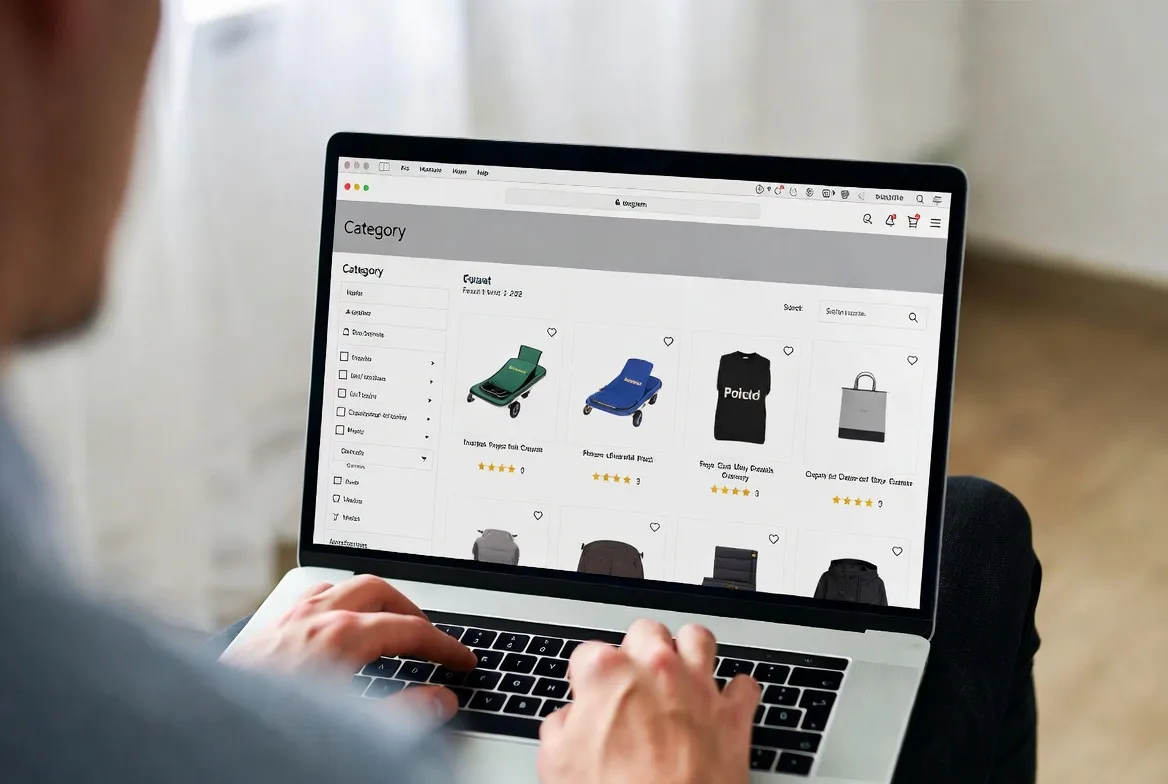
Faceted navigation—filters for size, color, price, brand—generates substantial duplicate content risks. Each filter combination can produce a unique URL: /womens-running-shoes, /womens-running-shoes?color=blue, /womens-running-shoes?color=blue&size=8. Suddenly your 50-product category spawns 500+ URLs with nearly identical content.
Manage this through strategic deployment of canonical tags, noindex directives, and URL parameters in Search Console. Canonical tags indicate to Google which version is the “authoritative” page when duplicates exist. For most stores, canonicalize all filtered views to the main category URL. Only permit indexation of filter combinations with meaningful search demand (like “women’s blue running shoes size 8” if that’s a frequent query).
Alternatively, employ URL parameters to inform Google these are filters, not distinct pages. In Search Console, configure how Googlebot should process parameters like “color” or “size.” This prevents squandered crawl budget on infinite filter combinations.
Category meta titles should target the primary keyword while remaining compelling. “Women’s Running Shoes – [Brand] | Free Shipping & Returns” surpasses both “Running Shoes” (too vague) and “Best Women’s Running Shoes 2026 Buy Online Free Shipping” (keyword stuffing).
Breadcrumbs enhance both user navigation and SEO. They generate additional internal links, clarify site structure, and surface in search results when properly marked up with BreadcrumbList schema.
Technical SEO Foundations for Ecommerce Sites
Technical problems establish ceilings on your SEO performance. You can compose perfect content and secure quality backlinks, but if your site architecture is compromised, you’ll never achieve your potential.
Site Architecture and URL Structure
Sound site architecture follows a pyramid: homepage at the apex, main categories one level down, subcategories next, and products at the base. Maintain products within 3-4 clicks of the homepage. Every additional click dilutes link equity and reduces crawling efficiency.
URL structure should be clean, descriptive, and consistent. Deploy: /category/subcategory/product-name not /p?id=8472 or /category/subcategory/product-name-blue-size-8-sku-12345. Shorter URLs perform marginally better, but clarity trumps brevity.
Don’t modify URLs without implementing proper redirects. Every URL modification without a 301 redirect sacrifices accumulated link equity and generates broken links. If you must restructure, map old URLs to new destinations and establish redirects before launching.
Managing Duplicate Content
Ecommerce sites produce duplicate content organically: products in multiple categories, manufacturer descriptions shared across stores, print-friendly pages, mobile versions. Search engines don’t penalize duplicate content as severely as SEO myths suggest, but they do select one version to rank—and it might not be yours.
Canonical tags resolve most duplicate content challenges. When a product surfaces in multiple categories (/mens/shoes/sneakers/product and /sale/shoes/product), canonicalize both to the primary category URL. This consolidates ranking signals.
For manufacturer descriptions, either rewrite them thoroughly or supplement extensively with unique content. If rewriting 1,000 product descriptions isn’t practical, prioritize your best sellers and highest-margin products.
Deploy HTTPS site-wide and select one domain version (www or non-www). Point all variations to your selected canonical version. Operating both http and https, or www and non-www, fragments your link equity.
Page Speed and Core Web Vitals
Page speed directly influences both rankings and revenue. Google’s Core Web Vitals (Largest Contentful Paint, First Input Delay, Cumulative Layout Shift) quantify user experience. Sites failing these benchmarks experience ranking penalties.
Largest Contentful Paint (LCP) should happen within 2.5 seconds. For product pages, this means your hero image and primary content must load rapidly. Optimize images aggressively, deploy a CDN, activate browser caching, and minimize render-blocking JavaScript.
First Input Delay (FID) quantifies interactivity. Users should be able to click, tap, or interact within 100 milliseconds. Excessive JavaScript from tracking pixels, chat widgets, and personalization engines destroys FID. Audit third-party scripts mercilessly—does that infrequently-used widget justify slowing every page load?
Cumulative Layout Shift (CLS) quantifies visual stability. Elements shouldn’t relocate as the page loads. Reserve space for images and ads so content doesn’t shift when they load. A product page where the “Add to Cart” button moves as images load generates both poor user experience and CLS problems.
Deploy Google PageSpeed Insights and Chrome’s Lighthouse to pinpoint specific issues. Concentrate on the highest impact items first: image optimization typically produces the largest improvements for ecommerce sites.
Mobile Optimization
Over 60% of ecommerce traffic originates from mobile devices, yet many stores approach mobile as secondary. Google’s mobile-first indexing means your mobile site determines your rankings, even for desktop searches.
Responsive design is fundamental—your site must adapt to any screen size. But genuine mobile optimization extends further: simplify navigation for thumb-friendly tapping, ensure tap targets measure at least 48×48 pixels, and reduce form fields to essentials. A checkout process demanding 20 form fields on a 6-inch screen guarantees abandonment.
Evaluate your site on physical devices, not merely browser emulators. Touch interactions, scrolling performance, and load times behave differently on actual hardware. An iPhone 13 Pro and a budget Android phone from 2024 provide vastly different experiences.
Accelerated Mobile Pages (AMP) has declined in popularity as mobile web performance improved, but rapid mobile pages remain essential. Prioritize performance over elaborate features. A simple, rapid mobile experience outperforms a feature-laden slow one every time.

Building an Ecommerce Link Strategy
Backlinks remain a top-three ranking factor. Quality links from relevant, authoritative sites communicate trust and expertise. For ecommerce, link building presents unique obstacles—product pages rarely attract organic links.
Internal linking deserves primary focus because you control it entirely. Connect from blog posts to relevant category and product pages. Connect from high-authority pages (like your homepage or popular blog posts) to pages you want to rank. Deploy descriptive anchor text: “men’s waterproof hiking boots” surpasses “click here.”
Develop a hub-and-spoke model: comprehensive guides (hubs) connecting to related products and categories (spokes). A guide to “Choosing Running Shoes for Different Terrain” naturally connects to trail running shoes, road running shoes, and cross-training shoes. This channels authority while delivering genuine value.
Securing external backlinks requires content beyond your product catalog. Buying guides, industry research, data studies, and expert roundups attract links that product pages never will. A study analyzing “10,000 Running Shoe Reviews: What Matters Most to Buyers” could secure links from running blogs, sports publications, and industry sites.
Product PR succeeds for unique, newsworthy items. Launching an innovative product? Sustainable materials? Unusual use scenario? Pitch relevant journalists and bloggers. A handmade product featured on a design blog secures both links and qualified traffic.
Digital PR strategies like data journalism, expert commentary, and newsjacking generate link opportunities. Analyze your sales data for interesting trends, survey your customers, or compile industry statistics. “Hiking Gear Sales Surge 40% as Remote Work Enables Weekday Trails” might interest outdoor recreation publications.
Reject link schemes: purchasing links, participating in link exchanges, or deploying automated link building tools. These tactics risk manual penalties that can devastate organic traffic overnight. One high-quality link from a relevant authority outweighs 100 low-quality directory links.
Guest posting on relevant industry blogs succeeds when executed ethically: deliver genuine value, don’t over-optimize anchor text, and target sites your customers actually read. A guest post on a popular hiking blog about “Essential Gear for Winter Backpacking” (connecting to your store) serves readers while building authority.
Common Ecommerce SEO Mistakes to Avoid
Thin content plagues ecommerce sites. Launching 500 products with 50-word descriptions and manufacturer photos doesn’t build authority. Begin with fewer products optimized thoroughly, then expand. A store with 100 well-optimized products outranks one with 1,000 thin pages.
Poor site structure buries products under 5+ clicks from the homepage. When your best-selling product requires navigating through Homepage → Shop → Category → Subcategory → Sub-subcategory → Product, you’re squandering link equity and frustrating customers. Flatten your hierarchy.
Neglecting long-tail keywords leaves revenue on the table. Everyone pursues “running shoes” (extremely competitive), but “women’s zero-drop running shoes wide toe box” has clear intent and manageable competition. Long-tail keywords convert better because they match specific needs.
Ignoring technical problems creates invisible barriers. Broken links, slow load times, mobile usability problems, and crawl errors prevent even exceptional content from ranking. Conduct regular technical audits (monthly for large stores, quarterly for smaller ones) and address issues promptly.
Over-optimization activates spam filters. Repeating your keyword 30 times in a 300-word description, stuffing keywords into alt text, or generating keyword-rich anchor text for every internal link appears manipulative. Write naturally for humans; search engines are sophisticated enough to interpret context and synonyms.
Blocking important pages in robots.txt or accidentally noindexing categories occurs more frequently than you’d expect. Always verify your robots.txt file and check for unintended noindex tags after site updates or platform migrations.
Forgetting about seasonal optimization sacrifices revenue. If you sell winter gear, optimize those pages in late summer before search demand peaks. Waiting until November to optimize “winter hiking boots” means missing the crucial early shopping season.
Ecommerce SEO in 2026 is about demonstrating genuine expertise and providing value beyond just selling products. Sites that combine technical excellence with truly helpful content—detailed guides, transparent comparisons, and authentic user reviews—consistently outperform those focused solely on optimization tactics.
Lily Ray
Product Page SEO vs. Category Page SEO
| Element | Product Page Approach | Category Page Approach | Priority Level |
|---|---|---|---|
| Primary Keyword | Specific product plus attributes (brand, model, size, color) | Broader category term with modifiers | High |
| Content Length | 300-500 words of original description | 400-800 words of category overview | High |
| Internal Links | Connect to category, related products, complementary items | Connect to subcategories, featured products, guides | High |
| User-Generated Content | Reviews, Q&A, customer photos | Minimal; emphasize curated content | Medium (product), Low (category) |
| Schema Markup | Product schema including price, availability, ratings | CollectionPage or ItemList schema | High |
| Image Optimization | Multiple angles, lifestyle shots, zoom capability | Category hero image, minimal decorative images | High (product), Medium (category) |
| Call-to-Action | “Add to Cart,” “Buy Now,” purchase-oriented | “Browse,” “Filter,” “View Products,” navigation-oriented | High |
| Update Frequency | Refresh when price or availability changes | Refresh seasonally or when adding products | Medium |
FAQs
Anticipate 3-6 months for meaningful traffic increases, 6-12 months for substantial revenue impact. New sites with minimal authority require longer than established stores. Quick wins exist—fixing technical errors or optimizing high-traffic pages can show results in weeks—but building authority and rankings for competitive terms demands patience. The timeline depends on your starting point, competition level, and how aggressively you execute. A store publishing one optimized product page weekly will see slower results than one launching 50 optimized pages monthly.
Product pages pursue specific, high-intent keywords (“Nike Pegasus 42 women’s size 8 white”) and emphasize conversion. Category pages pursue broader, mid-funnel keywords (“women’s running shoes”) and function as navigation hubs. Product pages require detailed specifications, reviews, and purchase-focused content. Category pages require broader educational content, subcategory organization, and filtering options. Both require unique content, but the depth and purpose differ significantly.
Focus on non-branded keywords unless you’re a new brand with zero recognition. Branded keywords (searches including your store or brand name) convert well but represent existing awareness—people already know you. Non-branded keywords (“organic cotton baby clothes”) capture new customers who don’t know your brand exists. The exception: if competitors rank for your brand name, defend that territory first. Otherwise, allocate 80% of effort to non-branded terms to expand your market.
Maintain the page live with an “out of stock” or “notify when available” option rather than deleting it or displaying a 404 error. When the product returns seasonally or restocks regularly, preserve the page to protect accumulated rankings and links. Include related product recommendations so visitors find alternatives. When the product is permanently discontinued with no replacement, 301 redirect to the most similar alternative or parent category. Never allow out-of-stock pages to display as available—that erodes trust and wastes ad spend if you’re running shopping campaigns.
Not strictly mandatory, but highly beneficial for most stores. Blogs capture top-of-funnel traffic, target informational keywords, and generate linkable assets that build domain authority. A hiking gear store can rank for “how to choose hiking boots” with a blog post, then connect to relevant products. Without a blog, you’re restricted to product and category pages, which struggle to rank for informational queries. The exception: when your products are extremely niche with minimal informational search volume, allocate resources to product page optimization instead.
Deploy /category/product-name for most stores. This generates clean, readable URLs while displaying hierarchy. For stores with deep category structures, /main-category/subcategory/product-name functions well, but avoid exceeding three levels. Keep URLs short and descriptive: /mens-running-shoes/nike-pegasus-42 surpasses /products/p?id=8472 or /mens/athletic-footwear/running/road-running/nike/pegasus/pegasus-42-2026-model. Consistency matters more than perfection—select a structure and maintain it. Modifying URL structures later requires redirects and risks sacrificing accumulated equity.
SEO for ecommerce requires a different methodology than content sites or local businesses. Your inventory is your content, your category structure is your information architecture, and every product page is both a landing page and a conversion tool. Success demands balancing search engine requirements with user experience—rankings mean nothing when visitors don’t convert.
Begin with foundations: clean site architecture, rapid load times, mobile optimization, and logical URL structure. Develop this with thorough keyword research aligned to your actual inventory. Optimize product pages with unique descriptions, quality images, and schema markup. Construct category pages that rank for mid-funnel keywords while serving as effective navigation hubs.
The stores that succeed in organic search approach SEO as an ongoing process, not a one-time project. Markets shift, competitors adapt, and algorithms evolve. Regular technical audits, continuous content improvement, and strategic link building compound over time. A product page optimized today might rank on page two initially, but with accumulated reviews, updated content, and earned links, it climbs to position three, then one, driving revenue for years.
The competitive advantage belongs to stores that view SEO as customer service at scale. Every optimized product page answers questions, every category description educates buyers, and every technical improvement removes friction. Execute these strategies systematically, measure results, and refine based on data. The organic traffic and revenue growth will follow.