
Running an online store involves more than uploading product photos and collecting payments. Once a customer completes checkout, you’ve got to get that item from your warehouse shelf to their doorstep—and how smoothly this happens determines whether they’ll come back or leave a one-star review.
The brands that nail their fulfillment strategy spend less time putting out fires and more time growing their business.
What Is Ecommerce Fulfillment?
Think of ecommerce fulfillment as everything that happens after someone clicks “place order” on your website. You’ve got to pull the right product from your shelves, protect it properly for shipping, slap on a label, get it to a carrier, and handle it when customers send things back.
Traditional stores have it easier—customers grab products off the shelf and leave. Online sellers need to recreate that immediate satisfaction through a backend operation that customers never see but definitely judge you on.
The logistics piece goes deeper than just sending boxes. You’re predicting what’ll sell so you stock enough (but not too much), placing inventory where it can reach customers faster, and building systems to handle returns without losing your shirt. A clothing retailer might warehouse heavy coats near Chicago distribution centers while keeping beach cover-ups closer to Miami, cutting both delivery times and shipping expenses.
Fulfillment strategy directly impacts customer lifetime value. Brands that deliver consistently in two days see 34% higher repeat purchase rates than those averaging five-day delivery. Speed and reliability aren’t perks anymore—they’re baseline expectations that determine whether customers come back.
Marcus Chen
Here’s what’s at stake: research shows 69% of shoppers won’t return to a retailer if their order misses the promised delivery window by just one day. One day. That’s the tolerance level you’re working with.
How the Ecommerce Order Fulfillment Process Works
Each phase of ecommerce order fulfillment creates opportunities to either impress customers or create problems that snowball into negative reviews.
Receiving and Warehousing Inventory
Products show up at your warehouse from manufacturers or suppliers. Your receiving team checks everything against what you ordered, looking for damage and making sure the count matches the invoice. Every item gets assigned a SKU number and entered into your tracking system.
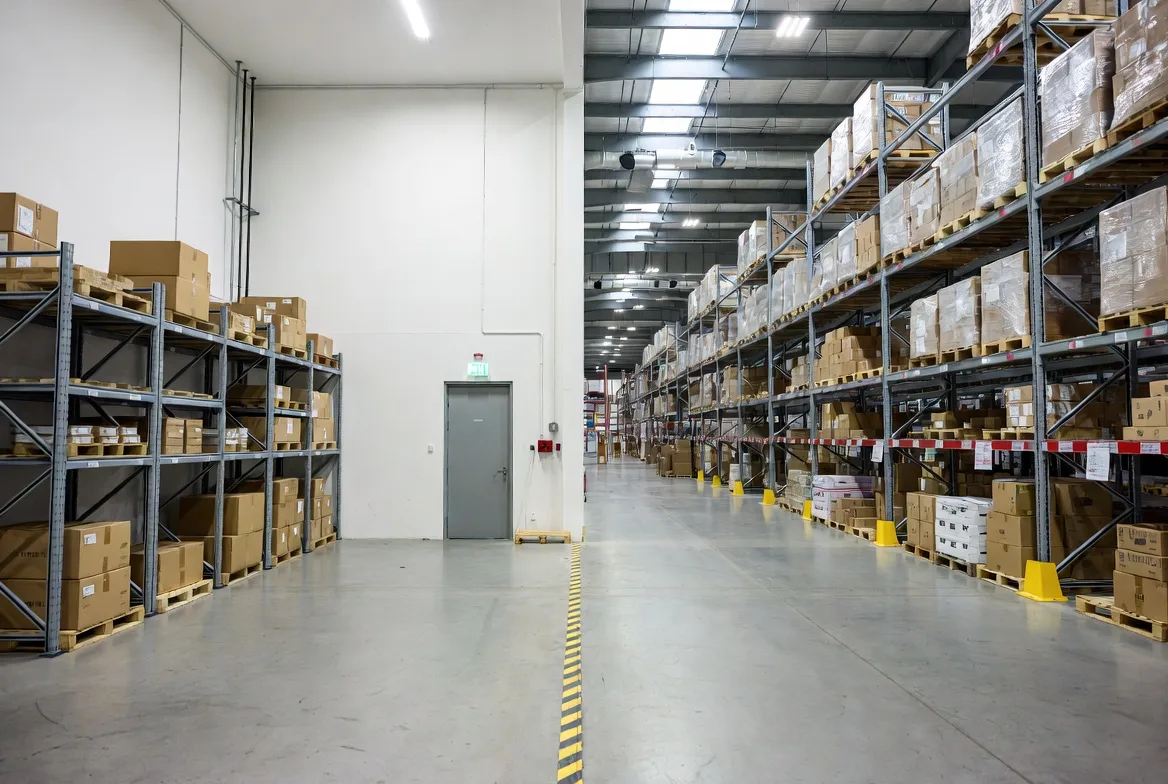
How you organize your warehouse matters more than most sellers realize. Products that fly off the shelves should live right next to your packing stations, not buried in the back corner. Slow sellers can occupy harder-to-reach spots. Got temperature-sensitive stuff like supplements or beauty products? They need climate control. Fragile items need protective shelving that won’t contribute to breakage.
Accurate inventory counts drive everything else. Miss one number, and your system says you’ve got stock when the shelf’s actually empty—leading to canceled orders and angry customers. The best operations skip annual inventory counts in favor of cycle counting, where you audit different sections regularly to maintain accuracy above 99%.
Pick, Pack, and Ship Operations
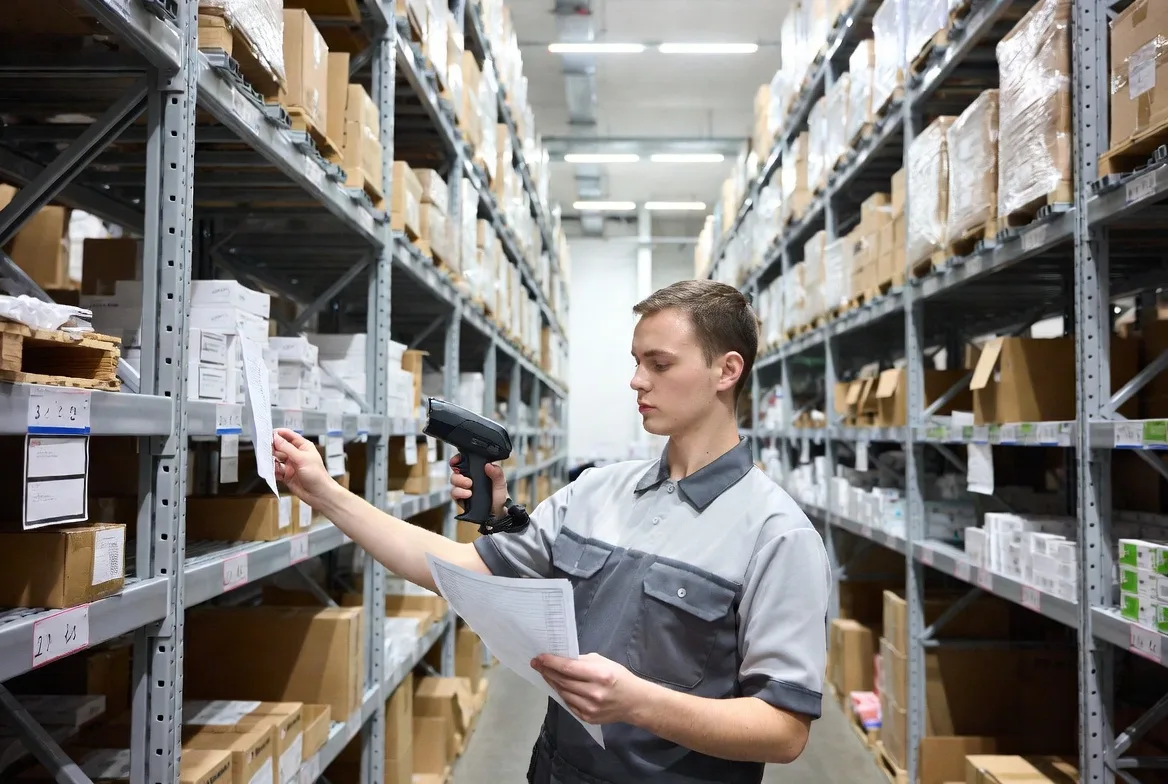
An order hits your system, and it immediately creates a pick list showing your team exactly which shelf holds each item. Smaller operations might have one person handle everything from start to finish. Bigger warehouses often use zone picking—different people grab items from their assigned areas, and everything meets at a central packing station.
Making pick pack ship ecommerce efficient depends on warehouse design and technology. Some operations use batch picking, where one person grabs items for ten orders in a single trip through the warehouse rather than making ten separate walks. Other facilities have workers wearing headsets that verbally guide them to products, leaving their hands and eyes free.
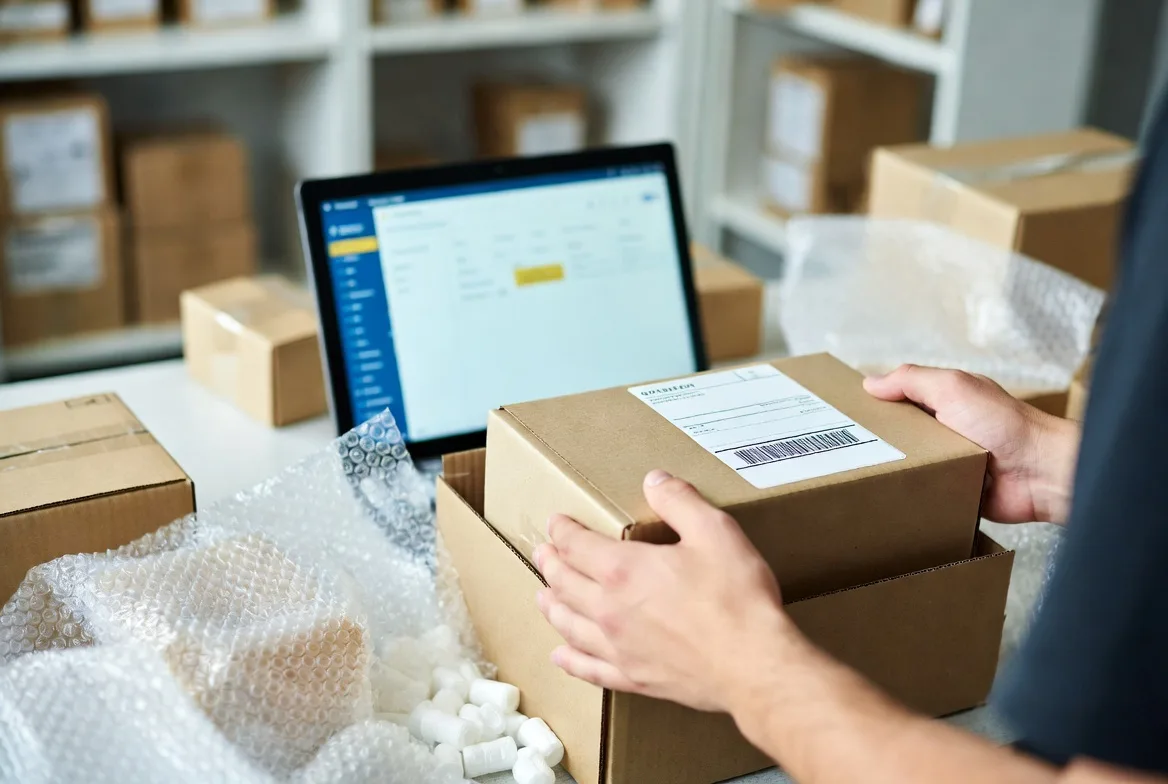
Packing becomes a balancing act between protection and cost. Too much packaging wastes money on bubble wrap and increases dimensional weight charges. Too little protection means damaged goods and returns. Smart warehouses stock various box sizes and use software that calculates the smallest package that’ll safely fit each order.
When it’s time to ship, the system compares real-time rates across carriers and picks whichever option meets your delivery promise for the least money. That two-pound package traveling 200 miles might go via a regional carrier for $4.50. Same package crossing the country? You’re looking at a national carrier charging $9.75. Good automation handles these decisions faster than you can blink.
Managing Returns and Reverse Logistics
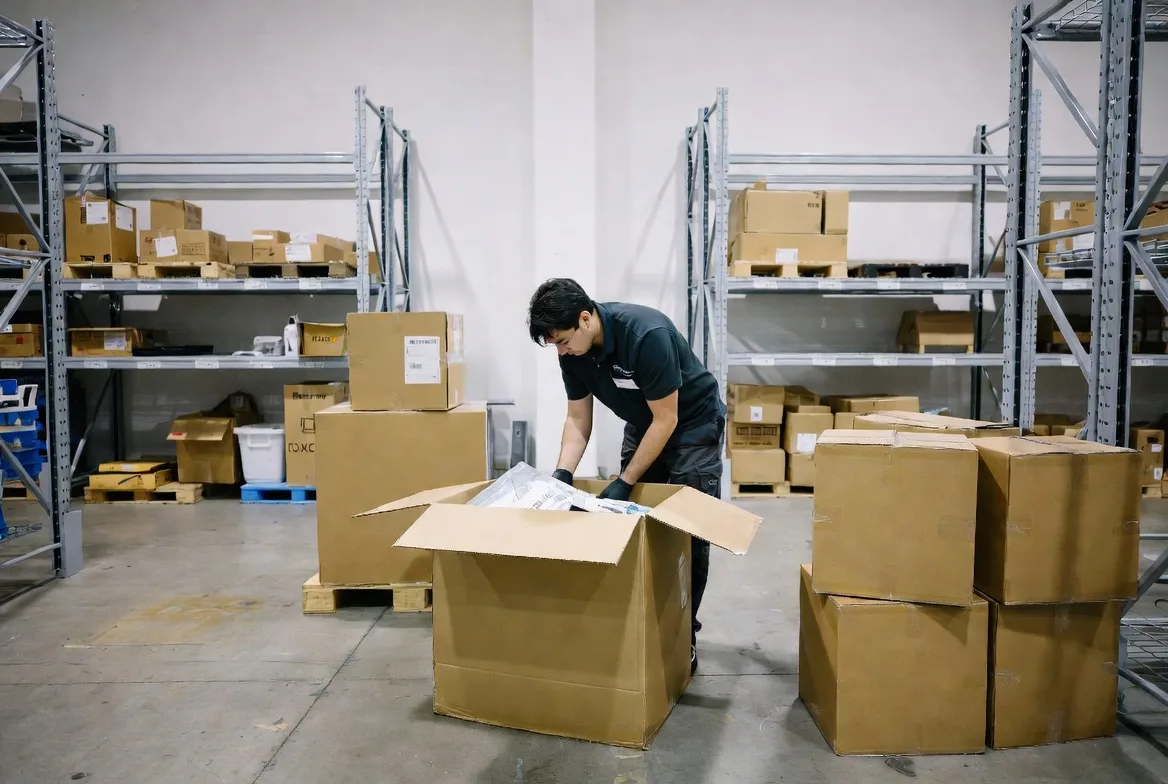
Returns cost more than any other part of fulfillment. Products come back, and somebody’s got to inspect them, decide what to do with them, and either restock, discount, donate, or trash them. Clothing sees return rates of 20-30%. Electronics typically run 8-15%.
Efficient reverse logistics starts with clear return instructions and prepaid labels that route products to the right facility. When returned items arrive, your team inspects each one to determine next steps: sell it as new, mark it as open-box at a discount, refurbish it, donate it, or dispose of it. Each choice carries different financial implications.
Return data tells you what’s wrong with your products. When a particular shoe style comes back marked “too small” 40% of the time, your product page needs better sizing guidance. Electronics returning as “defective” but testing perfectly fine? Your instruction manual probably needs work. Track return reasons and you’ll turn losses into actionable product improvements.
Types of Ecommerce Fulfillment Models
How you handle fulfillment represents one of those fork-in-the-road decisions that shapes your entire business trajectory. Each approach comes with its own set of compromises.
In-house fulfillment means you’re running your own warehouse and managing the whole operation yourself. You lease the space, hire people, buy equipment, and control every detail. This gives you maximum control over how packages look, quality standards, and customer experience touches. A craft beverage company might run their own warehouse specifically so they can include handwritten thank-you notes and branded tissue paper—details that third-party warehouses won’t bother with.
The catch? Fixed costs hit whether you’re busy or slow. You’re paying rent, salaries, and equipment costs whether you ship 100 orders this month or 1,000. Scaling up means finding capital for bigger facilities and more workers.
Third-party logistics providers run ecommerce warehouse fulfillment as their entire business model. You send your inventory to their warehouse, and they handle receiving, storage, picking, packing, and shipping. They typically charge receiving fees when your inventory arrives, monthly storage based on how much space you’re using, and per-order fees for picking, packing, and shipping.
The fulfillment center ecommerce approach turns your fixed costs into variable ones. Slow month? You pay less. Busy season? You pay more, but you’re not stuck with a warehouse that sits half-empty most of the year. Your store needs to integrate with their warehouse software so orders transmit automatically and you can see what’s happening with your inventory.
Dropshipping means you never touch the products at all. Customers order from you, you forward those orders to suppliers, and suppliers ship directly to your customers. You’re essentially just handling marketing and customer acquisition. This requires almost no upfront capital but leaves you with the thinnest margins and the least control. When your supplier runs out of stock or ships damaged products, you still own the customer relationship damage.
Hybrid approaches let you mix and match strategically. A supplement brand might handle their subscription boxes in-house because those require quality control and custom touches, while using a 3PL for one-time purchases that fluctuate with the seasons. Another company might fulfill domestic orders themselves but partner with international 3PLs for overseas customers.
In-House vs. Fulfillment Center: Which Is Right for You?
Whether to self-fulfill or outsource depends on your order volume, what you’re selling, where you’re headed, and how much capital you can deploy.
| Feature | In-House Fulfillment | Third-Party Fulfillment Center |
|---|---|---|
| Startup cost | Substantial upfront investment ($15K–$100K+ for space, racks, computers, software) | Minimal initial outlay (mostly just your inventory and integration setup) |
| Scalability | Constrained by your physical space and ability to hire | 3PLs absorb volume spikes without you adding capacity |
| Control | You decide every detail of packaging, quality checks, and timing | You’re limited to whatever standard processes the 3PL offers |
| Shipping speed | Entirely dependent on where your warehouse sits relative to customers | Often quicker through distributed networks positioned near major metros |
| Technology requirements | You purchase and maintain warehouse management systems and shipping platforms | Service fees include their technology stack |
| Labor management | You recruit, train, schedule, and manage all warehouse staff | The 3PL handles hiring, training, and all HR issues |
When doing it yourself makes sense: You’re shipping under 50 orders on a typical day, your products need special handling (like custom gift wrapping or personalization), your margins can’t absorb 3PL fees, or your brand experience demands packaging that warehouses handling hundreds of clients won’t accommodate.
Consider a jewelry maker selling $200 pieces with custom engraving and luxury packaging. Outsourcing to a warehouse that treats their products like any other SKU might erode the brand equity that justifies premium pricing. Sometimes the personal touch matters enough to justify the operational headache.
When outsourcing makes sense: You’re pushing 100+ orders daily, growing fast, experiencing major seasonal swings, expanding geographically, or your team’s skills are better spent on product development and marketing rather than warehouse management.
Imagine a consumer electronics brand that goes viral on TikTok. They can’t wait six months to lease warehouse space and hire staff. A 3PL partnership lets them scale from 50 to 5,000 daily orders in weeks instead of quarters.
Geography matters more than many realize. When 70% of your customers live in the Southeast but your warehouse is in Oregon, you’re paying premium shipping rates while disappointing customers with slow delivery. 3PLs with distributed warehouse networks position your inventory closer to where people actually buy it, reducing both cost and transit time.
Key Factors to Consider When Choosing a Fulfillment Partner
Picking a 3PL based solely on per-order pricing usually backfires. The cheapest quote often becomes the most expensive relationship when you discover hidden issues.
Location and network reach: Where do they actually have warehouses relative to where your customers live? A single facility in Kentucky can reach 80% of US addresses within two-day ground shipping. Coastal businesses might need both East and West Coast locations. Selling internationally? You need partners who understand customs regulations and have overseas warehousing.
Technology integration: Can your ecommerce platform talk to their warehouse system without constant glitches? Look for pre-built integrations with Shopify, WooCommerce, BigCommerce, or whatever you’re running. The API quality determines whether orders sync instantly or get stuck in limbo. Ask pointed questions about inventory visibility—can you check current stock levels in real-time, or do you wait for daily reports?
Shipping speed and carrier relationships: Which carriers do they work with? Have they negotiated volume discounts better than what you’d get directly? Can they deliver two-day ground shipping to your key markets? Some 3PLs specialize in speed with same-day order cutoffs at 5 PM, while others batch everything overnight.
Pricing structure transparency: Hidden fees will destroy your margins. Beyond the obvious per-order charges, dig into receiving fees (when inventory arrives), long-term storage surcharges (for slow-moving products), special handling costs (oversized or fragile items), return processing fees, and monthly account management charges. That attractive $4 per-order quote might become $6.50 once all fees appear on your invoice.
Request actual invoices from their current clients. Calculate true cost per order including every fee, not just the headline pick-pack-ship number.
Scalability and flexibility: Can they handle 10x your current volume without breaking? What happens during peak season—do they staff up or do orders pile up waiting to ship? How much advance notice do they need before a promotion that might spike volume? Some 3PLs impose daily order maximums that could cap your growth trajectory.
Customer service responsiveness: When inventory counts don’t match or orders ship to wrong addresses, how fast do they fix it? Do you get a dedicated account manager who knows your business, or do you email a general support queue and hope for the best? Check references from existing clients about how they handle problems.
Returns handling capabilities: What actually happens when products come back? Do they automatically inspect and restock, or do returns accumulate in a holding area waiting for you to provide disposition instructions? How do they distinguish damaged returns from resellable ones? Returns can destroy profitability—make sure the process runs efficiently.
Specialty capabilities: Selling products that require kitting (bundling multiple items together), lot tracking (supplements with expiration dates), or subscription box assembly? Verify the 3PL handles these services and understand exactly what they’ll charge for them.
Common Ecommerce Fulfillment Mistakes and How to Avoid Them
Even experienced online sellers trip over fulfillment errors that quietly drain profits and erode customer satisfaction.
Underestimating storage costs: A $200 monthly charge per pallet sounds reasonable until you realize slow-moving inventory piles up. Launch six product variants, and you might discover two generate 80% of sales while four collect dust and rack up storage fees. Monitor how fast inventory turns over, and liquidate slow movers before storage costs exceed the product’s value.
Ignoring dimensional weight pricing: Carriers don’t just weigh packages—they also measure them. They charge based on actual weight or dimensional weight, whichever costs more. For domestic shipments, they calculate dimensional weight by multiplying length times width times height, then dividing by 166. Ship something lightweight but bulky (like a bean bag chair) in an oversized box, and your shipping cost can triple. Right-sized packaging and poly mailers dramatically reduce these charges.
Poor carrier selection: Sending every package through the same carrier leaves money scattered across the table. Regional carriers frequently beat national ones for nearby deliveries. USPS Priority Mail often costs less than UPS or FedEx for packages under two pounds. Multi-carrier software compares rates automatically and selects the cheapest option that meets your delivery promise.
Inadequate inventory forecasting: Best-sellers selling out during peak season costs you real revenue. Overstocking products that don’t move ties up cash and generates storage fees. Use historical sales data combined with seasonality patterns and your marketing calendar (planned promotions, product launches, influencer campaigns) to forecast realistic demand. Safety stock—that extra inventory buffer protecting you against unexpected spikes—prevents stockouts, but holding it costs money. Calculate the right balance based on how long it takes suppliers to restock you.
Neglecting data analytics: Your fulfillment operation generates incredibly valuable data: average order value, bestselling products, return rates by SKU, shipping costs by delivery zone, and more. Sellers who ignore this data miss obvious optimization opportunities. Discovering that 40% of orders include two specific products together suggests creating a bundle. Noticing high return rates concentrated in one size indicates a listing error or sizing chart problem.
Weak returns process: Making returns difficult tanks repeat purchase rates. Requiring customers to pay return shipping or navigate Byzantine procedures sends them to competitors who make it easy. But overly generous policies invite abuse from serial returners. Find the middle ground with clear policies, prepaid return labels for defective merchandise, and modest restocking fees for buyer’s remorse returns when justified.
Failing to communicate tracking information: Customers expect automated emails with tracking links the moment orders ship. Silence creates anxiety and generates “where’s my order?” support tickets that waste your time. Ensure your platform or 3PL sends tracking notifications automatically.
FAQs
Shipping specifically means the transportation portion—getting packages from point A to point B via carriers like UPS, FedEx, or USPS. Fulfillment covers the complete journey: receiving inventory into your warehouse, storing it properly, retrieving items when someone orders, packaging them securely, creating shipping labels, handing packages to carriers, and processing returned merchandise. Shipping represents just one step within the larger fulfillment operation.
Running your own warehouse typically costs $5–$15 per order when you factor in wages, rent, equipment, and packing materials. Outsourcing to third-party providers usually runs $3–$10 per order for picking and packing services, plus monthly storage ranging from $0.40–$0.85 per cubic foot of space you’re using, plus receiving fees around $25–$50 per pallet when inventory arrives. Real costs depend on what you’re selling, order complexity, and volume. High-volume shippers negotiate substantially better rates.
Third-party logistics warehouses specialize in storing, picking, packing, and shipping products for online brands. Instead of each ecommerce business running its own warehouse, 3PLs provide fulfillment services to multiple clients simultaneously. They own the building, equipment, staff, and technology, charging clients based on space consumed and orders processed.
Efficient operations move from order placement to carrier pickup in 24–48 hours. Many 3PLs ship the same day for orders placed before their cutoff time (typically between 2–5 PM). In-house operations vary based on staffing and volume—small businesses might pack and ship once daily, while larger ones process orders continuously throughout business hours. Total delivery time equals fulfillment time plus however long the carrier takes (1–7 days depending on service level and distance).
Absolutely, though some providers set minimum volume requirements. Certain 3PLs want 100+ monthly orders, while others work with startups shipping 20–30 orders monthly. Smaller sellers pay higher per-unit fees since they can’t access volume discounts, but they still benefit from converting fixed warehouse costs into variable ones and leveraging professional operations. Many small businesses start fulfilling in-house and transition to 3PLs once daily order volume consistently exceeds what one or two people can efficiently pack.
Returned products arrive back at the warehouse where staff inspect each item’s condition. Items in resellable condition get added back into available inventory. Damaged or used merchandise gets flagged for your decision—sell at a discount, donate to charity, or dispose of it. Customers receive refunds according to your stated return policy, whether that’s full refunds, partial refunds minus restocking fees, or store credit. Well-run 3PLs complete this entire process within 2–3 business days of the return arriving.
Ecommerce fulfillment separates online businesses that deliver on their promises from those that disappoint customers with delays, damage, and frustration. The right approach—whether that’s running your own warehouse, partnering with a 3PL, or combining both strategically—depends on how many orders you’re processing, what products you sell, where you’re headed, and what your team does best.
Start by understanding your current situation. Calculate what fulfillment actually costs per order, including labor, materials, shipping, and the opportunity cost of your time spent managing it all. Identify where problems happen most frequently: running out of stock, shipping delays, return processing bottlenecks, or inventory counts that don’t match reality.
Businesses shipping fewer than 50 daily orders with straightforward products often find in-house fulfillment makes financial sense while preserving control over the customer experience. Beyond that threshold—or when experiencing rapid growth—3PLs offer scalability and geographic reach that’s nearly impossible to replicate on your own.
Choose fulfillment partners carefully. Prioritize technology integration quality, strategic warehouse locations, and transparent pricing over whoever quotes the lowest headline rate. The cheapest option frequently becomes expensive once hidden fees surface, service quality disappoints, or technology limitations create constant problems.
Monitor fulfillment metrics continuously: order accuracy percentage, average time from order to shipment, shipping cost per order, return rates by individual product, and how fast inventory turns over. These numbers reveal optimization opportunities and provide early warning of emerging problems before they damage customer relationships.
Remember that fulfillment isn’t a “set it and forget it” decision. As your business grows, products change, and customer expectations evolve, your fulfillment strategy should adapt accordingly. The approach that works brilliantly at 100 monthly orders might completely fail at 10,000. Regular evaluation ensures your operations scale alongside your ambitions instead of becoming the bottleneck that constrains growth.